The 2012 campaign will be remembered as the first four screen election.
The Internet has fundamentally transformed how voters receive information on candidates and issues. Access to political information no longer comes from one place, or one screen. That means that campaigns that adapted to this new reality - and adopted a four-screen strategy to persuade and connect with voters - more often than not won. The trend is clear: those who invest in online win. In fact, 9 of the top 11 US Senate races who spent more online with Google won on Tuesday.
Let’s look at how the four screens worked together in the closing days of the race.
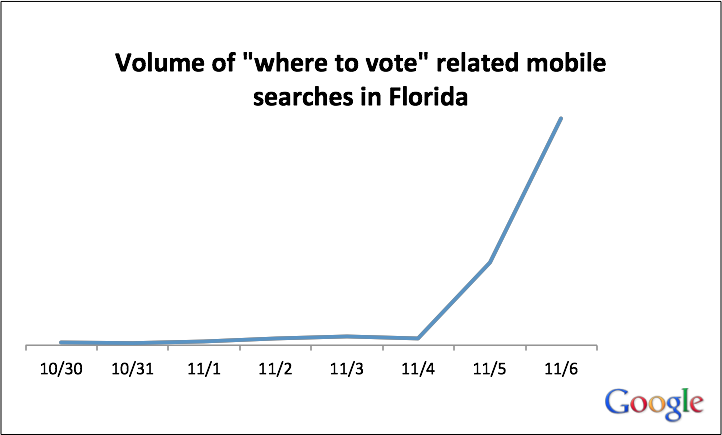
Of the four screens, mobile’s role in political campaigning grew the most from 2008. Voters use their devices to stay up to date about key issues, look up quick answers, or find last-minute information like where to vote. Candidates who recognized these behaviors and developed mobile strategies to reach people on their smartphones were able to drive voter interaction. Specifically, we found that as election day neared, voters turned to their mobile devices for election-related information.
The Internet has fundamentally transformed how voters receive information on candidates and issues. Access to political information no longer comes from one place, or one screen. That means that campaigns that adapted to this new reality - and adopted a four-screen strategy to persuade and connect with voters - more often than not won. The trend is clear: those who invest in online win. In fact, 9 of the top 11 US Senate races who spent more online with Google won on Tuesday.
Let’s look at how the four screens worked together in the closing days of the race.
Of the four screens, mobile’s role in political campaigning grew the most from 2008. Voters use their devices to stay up to date about key issues, look up quick answers, or find last-minute information like where to vote. Candidates who recognized these behaviors and developed mobile strategies to reach people on their smartphones were able to drive voter interaction. Specifically, we found that as election day neared, voters turned to their mobile devices for election-related information.
- Total US Mobile searches related to finding a voting location increased by 164% from Monday to Tuesday. This trend was even more pronounced in battleground states.
- Quite a few voters leave their homes on Election Day and are still undecided. On the day of the election, throughout the US, the majority of Obama-related searches occurred on mobile devices as millions of Americans stood in line and travelled to their polling places.
Search, especially on larger screens like laptops, is an essential voter tool for fact-checking and education. It is also a critical campaign tool for rapid-response and persuasion. We saw campaigns and issue advocacy groups use search to respond, educate or even ‘bracket’ events in real-time. There was a real shift toward voters using (and trusting) the Web as a fact-checker, especially around offline events like debates. 64% of voters use the Internet to verify or “fact check” a claim made by a candidate or issue group and it is clear that it is key to formulating voting decisions.
- In Maryland, where same sex marriage legislation was passed, total searches for gay marriage increased by 482% from the same period last year.
- Since April 2011, when Romney officially entered the race, over 700,000 videos mentioning Obama or Romney have been uploaded to YouTube, and these videos account for 2.8 billion views.
Television - especially around live campaign events like debates - is a powerful catalyst to drive action on digital devices. Savvy campaigns built presences across all screens to stay connected with voters that are driven online by TV to fact-check or research.
And, finally, while tablets are still a relatively new device, they distinguished themselves as an important tool this election. The most notable role that tablets played was as a couch companion, helping voters find more information and react to the things they saw on TV. While this TV + Tablet multi-screening was the most mainstream behavior, we are also seeing a growing number of people who are turning to tablets first to consume news and find information.
- 77% of TV viewers use another device at the same time in a typical day. (Google Multi-Screen Research)
And, finally, while tablets are still a relatively new device, they distinguished themselves as an important tool this election. The most notable role that tablets played was as a couch companion, helping voters find more information and react to the things they saw on TV. While this TV + Tablet multi-screening was the most mainstream behavior, we are also seeing a growing number of people who are turning to tablets first to consume news and find information.
- During the second Presidential Debate, energy-policy related searches on tablets spiked by 359% immediately after the question about gas prices. This shows how people reach for their tablets in response to things on TV.
Campaigns who don’t come to grips with these changing voter behaviors will have a harder time giving that victory speech on Election Night. Campaigns who go online and develop a multi-screen approach to persuading and connecting with voters will win. It has never been more clear that the road to victory requires a four screen strategy.
Posted by: Jennifer Gross, on behalf of the Politics & Elections Team


