Tampilkan postingan dengan label research. Tampilkan semua postingan

Senin, 12 November 2012

2012 was the breakthrough year for digital persuasion across 4 screens

The 2012 campaign will be remembered as the first four screen election.  

The Internet has fundamentally transformed how voters receive information on candidates and issues. Access to political information no longer comes from one place, or one screen. That means that campaigns that adapted to this new reality - and adopted a four-screen strategy to persuade and connect with voters -  more often than not won.  The trend is clear:  those who invest in online win.  In fact, 9 of the top 11 US Senate races who spent more online with Google won on Tuesday. 


Let’s look at how the four screens worked together in the closing days of the race.

Of the four screens, mobile’s role in political campaigning grew the most from 2008.  Voters use their devices to stay up to date about key issues, look up quick answers, or find last-minute information like where to vote. Candidates who recognized these behaviors and developed mobile strategies to reach people on their smartphones were able to drive voter interaction.  Specifically, we found that as election day neared, voters turned to their mobile devices for election-related information.
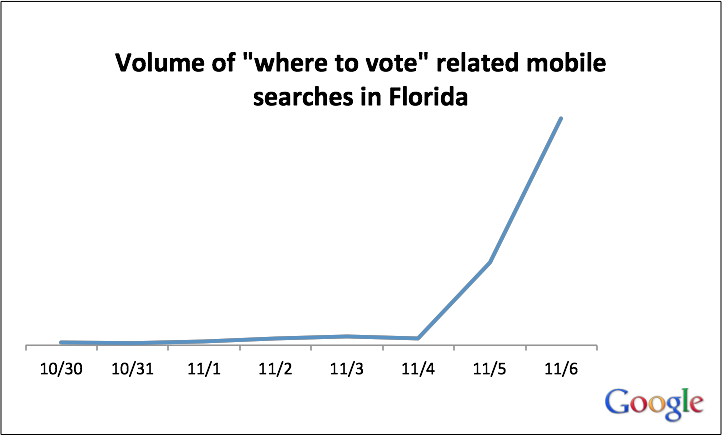
  • Total US Mobile searches related to finding a voting location increased by 164% from Monday to Tuesday. This trend was even more pronounced in battleground states.


  • Quite a few voters leave their homes on Election Day and are still undecided. On the day of the election, throughout the US, the majority of Obama-related searches occurred on mobile devices as millions of Americans stood in line and travelled to their polling places.
Search, especially on larger screens like laptops, is an essential voter tool for fact-checking and education.   It is also a critical campaign tool for rapid-response and persuasion.  We saw campaigns and issue advocacy groups use search to respond, educate or even ‘bracket’ events in real-time.  There was a real shift toward voters using (and trusting) the Web as a fact-checker, especially around offline events like debates.  64% of voters use the Internet to verify or “fact check” a claim made by a candidate or issue group and it is clear that it is key to formulating voting decisions.  
  • In Maryland, where same sex marriage legislation was passed, total searches for gay marriage increased by 482% from the same period last year.
  • Since April 2011, when Romney officially entered the race, over 700,000 videos mentioning Obama or Romney have been uploaded to YouTube, and these videos account for 2.8 billion views.
Television - especially around live campaign events like debates - is a powerful catalyst to drive action on digital devices.  Savvy campaigns built presences across all screens to stay connected with voters that are driven online by TV to fact-check or research.  


And, finally, while tablets are still a relatively new device, they distinguished themselves as an important tool this election. The most notable role that tablets played was as a couch companion, helping voters find more information and react to the things they saw on TV. While this TV + Tablet multi-screening was the most mainstream behavior, we are also seeing a growing number of people who are turning to tablets first to consume news and find information.

  • During the second Presidential Debate, energy-policy related searches on tablets spiked by 359% immediately after the question about gas prices. This shows how people reach for their tablets in response to things on TV.

Campaigns who don’t come to grips with these changing voter behaviors will have a harder time giving that victory speech on Election Night.  Campaigns who go online and develop a multi-screen approach to persuading and connecting with voters will win.  It has never been more clear that the road to victory requires a four screen strategy.

Posted by: Jennifer Gross, on behalf of the Politics & Elections Team

Kamis, 01 November 2012

New data shows surge in holiday mobile searches and ad clicks, signals marketer opportunity

With the holiday season just weeks away, we sought out to understand how mobile behavior changes during national holidays throughout the year, particularly when people have a day off from work or school. What we found was a surge in activity on tablets and smartphones during these holidays, showing that when people are away from the office kicking back at home or out shopping, they increasingly turn to their smartphones and tablets nearby. More surprisingly, while we consistently saw mobile searches spike on holidays, we discovered an even more pronounced surge in mobile ad clicks, signaling that people are particularly interested in shopping and connecting with businesses.

For example, while Americans celebrated Labor Day this year with barbecues, family trips and shopping, they also often turned to their mobile devices nearby. Searches on smartphones were 7% higher compared to those on a typical Monday, and searches on tablets jumped by 25%. But perhaps more interestingly, clicks on mobile ads spiked even more dramatically in comparison to other average days. The chart below shows that on Labor Day, ad clicks on smartphones grew 9% compared to the average number of ad clicks on a typical Monday, while ad clicks on tablets jumped 39%.


This means that not only are people searching more on their mobile devices during holidays, but they’re actively looking to connect with businesses. So whether shoppers are using their free time to pick up a last-minute gift or buy holiday party supplies, this behavior presents an important opportunity for marketers to engage the mobile shopper.

We see these same mobile trends during holidays throughout the year, but find that they’re particularly pronounced on big shopping days like Thanksgiving, Black Friday and Cyber Monday. For example, while smartphone searches last Black Friday rose by 17% compared to a normal day, ad clicks on smartphones that day jumped by 61%. Likewise, while tablet searches rose by 40% last Black Friday, clicks on tablet ads shot up by more than 100%, and stayed above average in the days following.


So what does all of this mean for businesses? Quite simply, it means that with people turning to more devices during the holidays, there are more opportunities for them to find and connect with you, whether they’re at home or on the go. Here are a few things that you can do to make sure you’re ready:

  1. Make sure that you have campaigns or new ad text for your holiday promotions or messages.
  2. Increase your budget cap on holidays to account for additional clicks.
  3. Adopt an always-on strategy to make sure your budget lasts throughout the day. Consumers are researching and shopping at any time throughout the day and you should make sure you can be found.
  4. Segment your historic campaign performance by device to understand how people interact with you across different devices like smartphones and tablets, and tweak your campaigns accordingly to capitalize.
  5. Expand keyword lists to include holiday-related terms and ensure you have keyword parity between your desktop and mobile campaigns so you’re reaching potential customers regardless of what device they’re using.

Posted by Ben Taggart, Mobile Analyst

Selasa, 28 Februari 2012

Mobile plays a leading role at the Oscars

Today we're sharing some search insights around the Oscars on the Think with Google site. Mobile continues to play an increasingly larger role in consumer search behavior as confirmed by the 2012 Oscars. Please see Think Insights for full information on which stars and advertisers were the big search winners in this year’s Oscar Awards, and how mobile impacted the search landscape. Mobile insights are excerpted below. 

While desktop searches still capture the lion’s share of searching during the Oscars, a closer look at Sunday’s ad-inspired searches show the prevalence of consumers using their mobile devices and tablets. These devices are generally always within arm’s reach of the consumer and therefore important players in the quest for immediate information, particularly during large-scale live events.

On-air advertisers benefitted from cross-screen behavior, as well. Queries prompted by on-air advertisements were conducted on mobile devices and tablets an average of 30% of the time -- perhaps great news for advertisers that the smartphone or tablet is taking place of the refrigerator run during commercial breaks.

This cross-media consumption behavior represents a tremendous opportunity for marketers.
While concurrent TV-PC usage is well established, new data released from Our Mobile Planet: Global Smartphone Research reveals that  51% of Americans report using the Internet on their smartphones while watching TV. Particularly relevant for marketers is that smartphone users search on their devices in response to ads they see on TV, with 58% of users reporting this behavior.

ABC’s much hyped and highly promoted upcoming dramedy, “GCB,” illustrates this growing cross-media behavior  as consumers watched the big screen and searched on the small screen.  Searches clearly spiked the two times that ABC aired the the GCB promos during the Oscars and were more pronounced on mobile.  The ads with Broadway legend Kristin Chenoweth and Designing Women star Annie Potts had consumers reaching for their smartphones and tablets for more information. 53% of GCB searches came from mobile, with 42% from smartphones and 11% from tablet users. 


A look at the data also shows that tablets are becoming increasingly common couch companions. Searches for vacation rental specialist homeaway.com as a result of their on-air advertising show that mobile queries were split almost evenly between tablets and smartphones. The combination of a tablet’s connectivity and comfortable screen size makes it a popular choice for consumers and is an important trend to watch for savvy marketers developing cross-media strategies. 


Fame Drives Fortune

From bridesmaids to Muppets to Marilyn Monroe, the 2012 Oscars leveraged the passions of an adoring public and their thirst for more glamour, gossip, and goods. More searches through more channels by an increasingly digitally-connected audience will continue to provide new opportunities for advertisers to reach and energize consumers.
Posted by Christina Park, Product Marketing Manager, Think with Google

New smartphone research: One quarter of smartphone Internet users in top markets have made a purchase on their phones

Yesterday we shared some topline insights into consumers’ love affair with their smartphones and why businesses must fall in love with mobile in 2012. Today we go deeper into key findings on mobile consumer behavior in six countries - USA, United Kingdom, France, Germany, Spain and Japan - from the new “Our Mobile Planet: Global Smartphone Users” research we conducted in January 2012 with Ipsos.  

Consumers love multi-tasking while using their mobile phones

  • In general Americans are the biggest mobile multi-taskers, with 81% having used their smartphone while engaging with other media.
  • 54% of UK smartphone users watched TV while engaging with their smartphone.
  • 36% of Spaniards exhibit true multi-screen behavior as they use their smartphones while also using another internet connected device such as their computer.
This offline media consumption causes consumers to search on their smartphones

  • Across most of these six markets, roughly 60% of smartphone users are searching because of an ad they’ve seen offline or in a store.
  • Smartphone owners in Spain lead the way in searching as a result of seeing an offline ad. More than two-thirds (68%) search because of something they saw offline, with 62% searching as a result of something they saw on TV.
  • Half of German smartphone users (49%) have searched because of something they’ve seen in a store, and one-third (34%) of French smartphone users have searched on their mobile due to an ad they’ve seen in a magazine.
More than 90% of global smartphone users are searching on mobile, making it a truly mainstream behavior


  • 99% of smartphone users in Japan have used a search engine on mobile. This means that practically everyone who’s gone online on mobile has searched on their phone.
  • Mobile search is a frequent activity. In most of these six countries more than 75% of smartphone Internet users search at least once a week.
Consumers Take Action After Looking for Local Information
  • 92% of Americans use their smartphones to look for information about local businesses or services.
  • Local information seekers take action. 81% of French smartphone users who’ve looked for local information then acted on it with a quarter (26%) having called the business and 43% having visited the business.
  • Globally, 1 out 5 smartphone users in all six countries made a purchase after looking for local information, whether in-store or online.
One quarter of global smartphone Internet users have made a purchase on their smartphone


  • Japan leads the way in mobile commerce with 40% of smartphone Internet users having made a purchase on their phone.  One third of Americans (34%) and approximately a quarter of those in the European countries have made a purchase.
  • Mobile shoppers are frequent purchasers. Across all markets, more than 50% of those who’ve made a mobile purchase do so at least on a monthly basis. In Spain, 64% of mobile shoppers make a purchase at least monthly, with 15% purchasing on a weekly basis.
Smartphones Influence Consumer Purchase Decisions & Channels
  • Nearly one in four (26%) French smartphone owners say they intentionally have their mobile with them to compare prices and get product information. And the French say they have changed their mind about purchasing something in-store (19%) or online (17%) as a result of information they gathered on their smartphone.
  • Smartphone research also leads to purchases online and offline.  37% of UK smartphones Internet users have bought something online and 26% of German smartphone users have made a purchase offline in-store or over the phone after having researched something via their smartphone.
These insights into mobile consumer behavior have clear implications for businesses. The companies that make mobile central to their marketing strategies will have an advantage in engaging with the mobile consumer. Savvy advertisers should adopt integrated marketing campaigns to take advantage of consumers’ natural multi-tasking media behavior. Businesses should also develop cross-channel strategies that make use of mobile as a bridge between the online and offline world as consumers shop and look for local information.

Download the “Our Mobile Planet: Global Smartphone Users” report to learn more about mobile consumer behavior and smartphone usage in the United States, United Kingdom, Germany, France, Spain and Japan.

Posted by: Dai Pham, Google Mobile Ads Marketing

Senin, 27 Februari 2012

Consumers love their smartphones. Now businesses must fall in love with mobile.

Consumers are having a love affair with their smartphones. They have become the first thing we reach for in the morning and the last thing we put down at night. How do we know? We asked them. In January, we completed our new “Our Mobile Planet: Global Smartphone Users” research, conducted with Ipsos, to drive a deeper understanding of how consumers use their smartphones.

Smartphone ownership has jumped globally - increasing 11% to 44% of the total population in Spain and by 7% to 38% of the total population in the US.  Smartphone owners are always using their device - in France, 90% use their mobile devices to access the web every day.  Smartphone owners are using their device everywhere - in Germany, 67% of smartphone owners use their mobile device while on public transport. Smartphone owners are not just browsing, they are taking action - in the UK, 84% of smartphone owners look for local information on their mobile and 78% take action afterwards such as calling or visiting the business.

This consumer love affair with their mobile devices is transforming how consumers connect and live their lives. It is also transforming industries, creating new opportunities and changing how businesses engage with their customers. I believe we will see significant advances in mobile this year and the companies who fall in love with mobile will be best positioned to capitalize on them. Here are my 12 predictions for the major developments we will see in mobile in 2012:

  1. More than 1 billion people will use mobile devices as their primary internet access point.
  2. There will be 10 days where >50% of trending search terms will be on mobile
  3. Mobile’s role in driving people into stores will be proven and it will blow us away
  4. “Mobile driven spend” will emerge as a big category
  5. Smartphones will prove exceptional at driving a new consumer behavior
  6. Tablets will take their place as the 4th screen
  7. New industry standards will make mobile display easy to run
  8. 5 new, mobile first companies will reach the Angry Birds level of success
  9. The ROI on mobile and tablet advertising will increase as a result of the unmatched relevance of proximity
  10. The intersection of mobile and social will spark a dramatic new form of engaging consumers
  11. 80% of the largest 2,000 websites globally will have an HTML5 site
  12. One million small businesses globally will build a mobile website
Businesses are no longer asking why do I need to go mobile. Now they are asking how do I go mobile. How can my brand find success in the mobile space? How can I maximize the relationship with my customers on mobile? The answer is to truly operationalize mobile. This year we are challenging businesses to fall in love with mobile, align their organization for mobile success, and create a mobile website.  The companies who choose to ignore their mobile customers will miss an incredible opportunity and risk getting left behind.  So get going.

Download the “Our Mobile Planet: Global Smartphone Users” report to learn more about smartphone usage and mobile consumer behavior in the United States, United Kingdom, Germany, France,  Spain and Japan.

Posted by Jason Spero, Head of Global Mobile

Senin, 13 Februari 2012

Smartphones and tablets influence consumer purchasing decisions on mobile, online and in store

We know consumers love their mobile and tablet devices, but we are just beginning to develop a strong understanding of how they engage with these devices as they make their purchase decisions. To gain greater insight into this key behavior, we partnered with Ipsos during the 2011 holiday shopping season to study online shoppers. We uncovered a number of interesting consumer behaviors across desktop computers, smartphones and tablets. The powerful data we uncovered can drive best practices for advertisers at every holiday and year round.

The first key mobile insight every advertiser should know is that consumers use their smartphones at many different points in their purchase path. 41% of those who used their mobile phones to help with shopping said they made a purchase directly on their smartphone. 46% said they researched an item on their smartphone then went to a store to make their purchase. 37% said they researched an item on their smartphone then made their purchase online.


Another key mobile insight that emerged is that consumers used all three devices throughout the research process, but some activities were more popular on specific devices. Consumers who owned tablets read product reviews and looked for product information more from their tablet devices than from their desktop computer or smartphone. This is likely due to the combination of the large screen and portability of the device that enables consumers to use it more often and in more places. Consumers are carrying tablets with them to the couch, while in the kitchen, and even to bed.

Not surprisingly, more consumers used their smartphones to contact a retailer. With the natural calling ability of phones and many click-to-call phone numbers on websites and in ads, smartphones make it easy to contact retailers, whether to see if the store has the product in stock, get directions or find store hours.


While the 2011 holiday season is now firmly behind us, it’s clear that smartphones and tablets are only going to become a bigger part of the consumer shopping experience. Among consumers that used their devices to shop last year, 80% of smartphone shoppers and 70% of tablet users said they used their device more frequently this year.

To stay ahead of this shift in consumer behavior, advertisers need to make sure they have a mobile optimized site, make it easy for customers to reach them with click-to-call and deliver a seamless experience between online and offline in-store. It’s the advertisers who engage with their customers across all three devices that will have a distinct advantage in 2012.

To learn more about consumer shopping behavior across the desktop computer, smartphone and tablet and view a full report on shopper insights, go to Post Holiday Learnings for 2012.

Posted by: Dai Pham, Google Mobile Ads Marketing

Selasa, 07 Februari 2012

Super Bowl MVP: The mobile device - 41% of searches for Super Bowl TV ads during the game came from mobile devices

What were you doing on Super Bowl Sunday?  Like many of the 111 million people around the world who tuned into the game, you were probably lounging comfortably on your friend’s couch or sitting in a neighborhood bar with some buddies, holding a deliciously unhealthy snack in one hand... and your smartphone or tablet in the other.  

Multi-tasking while watching TV isn’t new, but nowadays smartphones and tablets are also becoming popular couch companions. Mobile devices have driven increases in total searches because of their always on, always-with-you nature. During the Super Bowl, 41% of Google searches in the US related to Super Bowl TV ads came from mobile devices. By looking at a selection of specific Super Bowl related queries both during the game and one week before, we found that the number of searches on these terms increased at a significant rate across all devices and was particularly high for mobile. Super Bowl ad related searches in the US rose 200% on desktop, 970% on tablets and a whopping 2700% on smartphones.

For example, when Clint Eastwood talked about “Halftime in America” in the moving Chrysler spot, viewers were increasingly reaching for their mobile devices to learn more.  Smartphone searches on his name jumped nearly 5500% during the game. Here is a look at what happened with some other popular terms on mobile devices:

Smartphone and Tablet Search Volume Increase During Super Bowl


It’s clear that multi-tasking on small screens while watching the big screen is quickly becoming the new norm.  Nielsen reported in a recent study that about 40% of tablet and smartphone users in the U.S. used their devices daily while watching TV.  They pick up their smartphones and tablets because they’re often the closest and most convenient internet-enabled devices.  

For advertisers, these big spikes in mobile search volume in response to TV ads point to the increasing importance of having an integrated mobile strategy.  Advertisers are beginning to see that mobile can deepen engagement with their brands and extend the value of their ad buy  beyond the 30 seconds on air. For example, Toyota’s ads encourage users to ‘Shazam’ the TV ad for a chance to win a new Camry. And by integrating a mobile search ad campaign with their Super Bowl TV ad, Volkswagen ensured mobile users could find and continue watching their ad during and after the game.

So what can we expect for Super Bowl XLVII?  Perhaps some party invites that specify BYOC* (*Bring your own charger).


Posted by: Dai Pham, Google Mobile Ads Marketing

Rabu, 25 Januari 2012

New research: Global surge in smartphone usage, UK sees biggest jump with 15% increase

Mobile devices are mainstream. In fact, according to our newest research more consumers in the US, UK, Germany, France and Japan use a mobile phone (feature phone or smartphone) than a computer (desktop or laptop).

But our most significant findings centered on the clear consumer shift to smartphones. This trend was evident in all countries, with the UK showing the largest increase in smartphone usage from 30 to 45% of the total population. We also found that the demographics of smartphone owners are shifting. Smartphone usage among females increased in all five countries. Smartphone ownership also rose among those aged 45+ in the US, UK and France. 


We partnered with Ipsos to conduct this research with a goal of gaining greater insight into consumer usage of mobile devices, the shift to smartphones and the emergence of tablets as a fourth screen. This study was fielded amongst the total population in the US, UK, Germany, France and Japan. Phase 1 of the research was conducted in January and February 2011 and Phase 2 in September and October 2011.

Some of the key findings of this new research include:

  • Consumers are clearly shifting from feature phones to smartphones. Smartphone penetration reached 45% in the UK, 38% in the US and France, 23% in Germany and 17% in Japan.  
  • Consumers are increasingly using their smartphones for Internet access. Germany saw the biggest increase with the percentage of smartphone owners using their device for daily Internet access jumping from 39% to 49%, while Japan had the highest percentage accessing the Internet daily on their smartphone at 88%.  A little over two-thirds of smartphone users in the US and over half of smartphone users in the UK access the mobile Internet daily.
  • Smartphone owners are continuing to get online on their computers. Across all five countries approximately 75% of smartphone owners said they continued to use their computer to access the Internet daily.  
  • Consumers are embracing tablets as the fourth screen. Tablet usage increased across all five countries with the highest penetration amongst the total population in the US at 11%. The rate of tablet usage is even higher amongst smartphone owners - hitting 17% in the US, 11% in Japan and 10% in the UK.
Download the PDF report here to see the full set of data from this research.

Posted by: Nicole Leverich, Google Mobile Ads Marketing

Rabu, 30 November 2011

Consumers on tablet devices: having fun, shopping and engaging with ads

Tablets have quickly emerged as a distinct third digital screen in consumers lives that fill the gap between desktops and smartphones. But there are still many open questions about exactly how consumers are using them. We explored tablet search trends earlier this year, but wanted to dig deeper and answer key questions such as: What are the contrasts between tablet use, laptop use, and smartphone use and how are consumers engaging across these devices? What are the most common activities (playing games, searching, reading, etc.) that tablets are used for? What ads are most relevant and useful based on how people are using the devices?

Tablets are for fun, entertainment, relaxation, while laptops are for work
One of our studies, a diary study that had people record every occasion that they used their tablet over a two-week period, found that most consumers use their tablets for fun, entertainment and relaxation while they use their desktop computer or laptop for work. Tablet devices are personal - 91% of the time that people spend on their tablet devices is for personal rather than work related activities. When a consumer gets a tablet, we’ve found that they quickly migrate many of their entertainment activities from laptops and smartphones to this new device.

Tablet owners are building the device into their daily routine. Our research found that the most frequent tablet activities are checking email, playing games and social networking. We also found that people are doing more activities in shorter bursts on weekdays (e.g. social networking, email) while engaging in longer usage sessions on weekends (e.g. watching videos/TV/movies).

Tablets are multi-tasking devices with at least 42% of activities occurring while doing another task or engaging with another entertainment medium. Of all the activities that people do on tablets, checking email, playing games, social networking and searching are the ones most frequently done in front of the TV. Many consumers also used their tablets to check email while eating, and listen to music while cooking.


The activities shown in the above chart were self-reported by respondents.


Tablets primarily stay home, few travel
But unlike smartphones that go everywhere and laptops that travel between work and home, few consumers take their tablets with them when they leave the house. However, consumers do take their tablets on vacation or work trips where they use them as a laptop replacement and a small number take them on their commute. Interestingly, our recent research found that tablets are for the most part a one-person device, although there are consumers who share their tablet with other family or household members.

Tablets are, however, mobile within the home, with the highest usage taking place on the couch, from the bed and in the kitchen.


The activities and locations shown in the above chart were self-reported by respondents.


Consumers are shopping on tablets
Many consumers do a lot of window shopping on their tablet and our data shows that they are making more and more purchases on their tablet devices. Indeed, tablets figure to be a significant new way for people to be shopping this holiday season. While shopping they are engaging with familiar brands through social media sites, deals discounts, and navigating directly to trusted shopping sites.

We also found that people are using their tablets for activities that they are also doing in the real world, such as searching for something in their local area, shopping (browsing and purchasing), and managing finances.

For many people, websites and apps designed for smartphones just don’t cut it on tablets. Instead consumers are taking advantage of the bigger screen and prefer using fully featured apps and the full desktop sites on their tablet.

We found that some of those activities also extend to additional devices (e.g. smartphone, laptop, etc.). These activities included shopping (both browsing and purchasing), searching for information, managing finances, checking the calendar and checking email.


Consumers don’t view ads differently on tablets, but they do expect more interactivity
Consumers are engaging with useful, relevant and rich ads that take advantage of the touchscreen interface on tablets. Some consumers expect more interactivity from ads on tablets than they do from ads on their desktop computer.

We believe that tablet ownership will continue to rapidly grow in 2012 and that tablet usage may change over time, particularly as smaller devices come on the market. We plan on continuing to conduct research to understand consumers’ uses of their tablet devices and are excited to share these research insights with you.

Posted by: Jenny Gove and John Webb, User Experience Research, Mobile Ads

Rabu, 26 Oktober 2011

Spain leading the smartphone revolution in Europe


Did you know that 33 % of the Spanish population actually has a smartphone (Ipsos GmbH & TNS Infratest)? Through the recently released research site ourmobileplanet.com we have seen that among major European countries Spain is now leading the smartphone revolution. The study reveals that in terms of parallel media usage, 50 % of Spanish smartphone users are actively browsing the Internet while listening to music and 35 % of users are in fact using the Internet on another device simultaneously. The Spanish are also actively using their mobile when searching their neighbourhood; 55 % have looked up directions or used a map and 45 % have performed a local search for a business.
Spain has highest smartphone penetration in Europe
And how are companies responding to this situation? During Think Mobile we held a few weeks ago in Madrid, eDreams & Telepizza shared how they are building their mobile strategy and The Cocktail highlighted mobile trends and the new mobile user experience in Spain. An example we mentioned earlier on this blog is MeliĆ” Hotels International, who have seen an increase in mobile transactions by twelve since they launched their mobile site. Although we have these great examples of companies who are embracing mobile, our internal data shows that only 10 % of large companies in Spain have developed a mobile website.
Alberto Knapp, CEO of Cocktail presenting at Think Mobile
Therefore, to catch up with the mobile user, businesses need to go mobile now. Find out how with the presentations and mobile research statistics from Think Mobile Spain.

Posted by Frank Albert Coates, Product Marketing Manager, Mobile ads & Laura Abarquero, Head of Mobile advertising Spain

Selasa, 06 September 2011

Holiday Retail Mobile Insights

Now that the final days of summer have come to an end, retailers are in the thick of planning for the busy holiday shopping season.  As you start to plan your campaigns, it's important to take a step back and look at how consumers are using their mobile and tablet devices to drive in-store and on-device purchases.  Here are a few insights that may surprise you:

  • We project that this year 15% of total “Black Friday” searches will be from mobile devices based on historical growth rates.
  • Many advertisers do not realize that mobile users actively search for last minute holiday gifts and to locate stores to purchase these last minute gifts.  In fact, we project that 44% of total searches for last minute gifts and store locator terms will be from mobile devices this holiday season based on historical growth rates.  
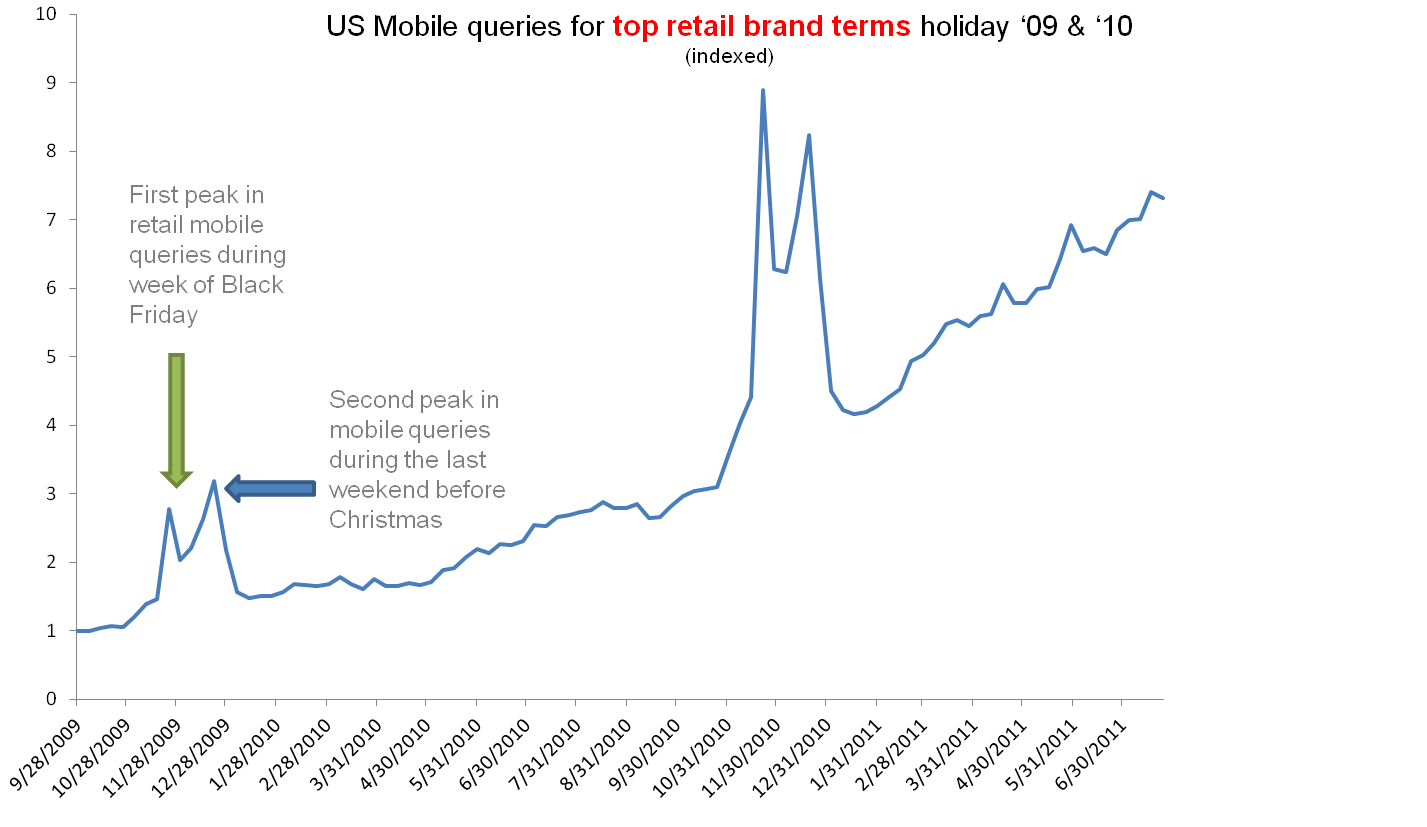
  • In fact, looking back on the past two holiday seasons, we see a “double peak” in search volumes for retail brands around first Black Friday and then the week before Christmas as mobile users locate stores for last minute shopping.  These shoppers may have missed the deadline for free shipping and are motivated to locate and shop at brick and mortar locations.  Here is the data from the holiday season in 2009 & 2010 showing this double peak:


  • The important thing to keep in mind is that these mobile searches drive in-store purchases: 65% of high end device users report that they have used their device to find a business, and then made a purchase at that business in person according our holiday retail survey of users in the AdMob network.
  • Retailers should be sure to plan for the tablet audience when it comes to driving on-device conversions.  Ebay has stated that tablet users spend 50% more than PC users, have higher AOV, and have higher or equivalent conversion rates.
  • According to our survey, greater than 33% of both smartphone users and tablet users plan to start their shopping before Thanksgiving, so smart marketers will start their campaigns early this year to reach these consumers.

Whether your goals are branding or direct response, Google Mobile Ads can help you with strategies to reach and engage your target audience and drive customers to convert on tablets, on mobile devices, and in your stores.  Contact your Google Mobile Ads sales representative to learn more.

Posted by Johanna Werther, Sr. Product Marketing Manager, Mobile Ads